
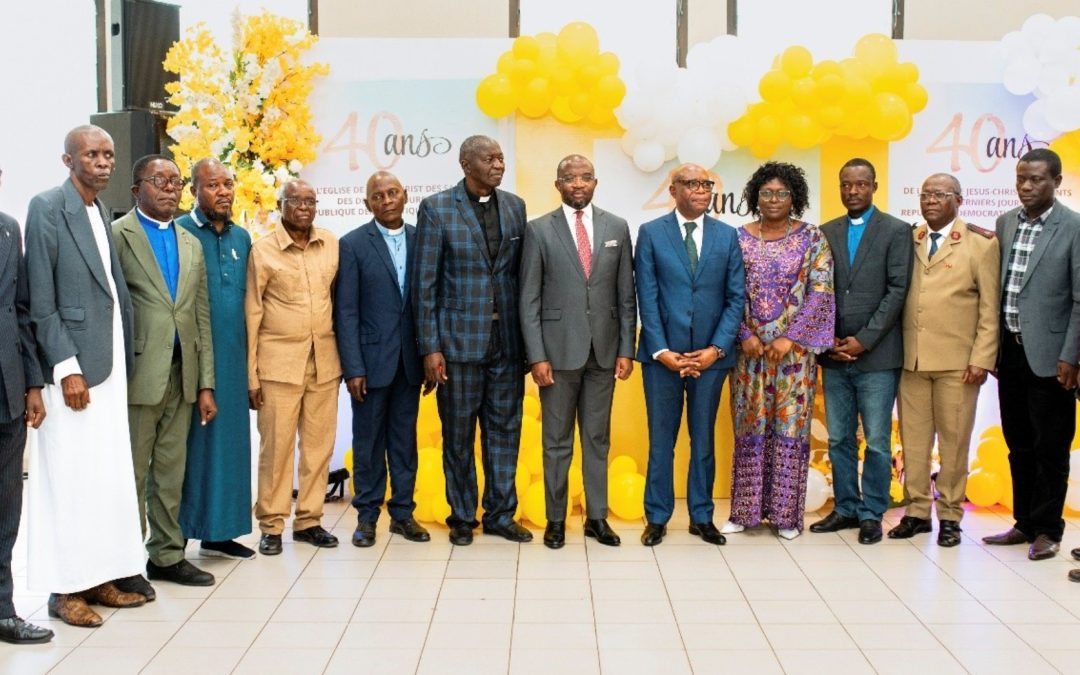
KINSHASA, Democratic Republic of the Congo — The Church of Jesus Christ of Latter-day Saints has marked 40 years since receiving official recognition in the Democratic Republic of the Congo, celebrating four decades of growth, service and expanding religious activity across the country.
Government officials, religious leaders, Church leaders and members gathered in Kinshasa for a commemorative ceremony reflecting on the Church’s history in the country and honoring early members whose faith and perseverance helped establish what has become one of the Church’s largest and fastest-growing communities in Africa.
The Church received legal recognition in what was then Zaire in April 1986. Missionaries Ralph Bay Hutchings and Jean Hutchings had arrived in Kinshasa two months earlier, and a district was organized later that year. The Kinshasa Mission was created in 1987.
On August 30, 1987, Elder Marvin J. Ashton of the Quorum of the Twelve Apostles, accompanied by Elder Alexander B. Morrison, a General Authority Seventy, dedicated Zaire for the preaching of the gospel during a gathering in Binza, Kinshasa.
During the anniversary celebration, Elder Édouard Ngindu, a Church historian and senior missionary serving in Kinshasa with his wife, presented a history of the Church and reviewed milestones that led to its establishment and expansion in the country.
President Banza, a mission president, also reflected on the Church’s early years, recalling meetings that were held in his family home about four decades ago. His remarks highlighted the sacrifices of early Congolese members and the role they played in building local congregations.
The celebration also focused on the Church’s humanitarian work. Brother Didier Mutombo, representing Church humanitarian services, highlighted projects involving health care, education, clean water, emergency relief, food security and self-reliance.
Among those attending was Marc Ekila Likombo, the country’s Minister of State and Minister of Vocational Training, who congratulated the Church on its 40 years in the country and recognized its spiritual, educational and humanitarian contributions.
Representatives of the National Council of Religions for Peace also participated. Colonel Ntemi Lukombo Esaïe of The Salvation Army praised the Church’s work in promoting peace, interfaith cooperation, family values and community development.
Elder David Ngabizele, an Area Seventy who presided over the ceremony, expressed gratitude for the Church’s development during the past four decades and encouraged members to continue serving God and their communities.
“For forty years, the Lord has prepared His people in the Democratic Republic of the Congo, strengthened them through periods of trial, and led them to remarkable growth,” Elder Ngabizele said.
He also addressed younger members, describing the anniversary as more than a reflection on the past and encouraging the rising generation to continue building on the foundation established by earlier Church members.
The Church has grown significantly since receiving legal recognition. According to Church statistics cited in the anniversary report, the Democratic Republic of the Congo now has more than 159,000 members, organized into 49 stakes, 13 districts, 490 wards and branches and nine missions.
Temple development has also expanded. The Kinshasa Democratic Republic of the Congo Temple was dedicated in 2019, while another temple is under construction in Lubumbashi. Temples have also been announced for Kananga and Mbuji-Mayi.
The anniversary program included choir performances and cultural presentations highlighting Congolese heritage, alongside historical and humanitarian presentations.
Church leaders said the celebration honored both the pioneers who helped establish the faith in the Democratic Republic of the Congo and the generations of members who have continued its growth throughout the country.
Four decades after gaining official recognition, the Church continues to expand its congregations, missionary work, humanitarian programs and temple presence in the Democratic Republic of the Congo.
Related posts:
 Church Clarifies Caffeine Use to Latter-day Saints
 Church Leaders Encouraged Members To Extend Love And Encouragement To The LGBT Members
 Church Members In West Virginia Have Been Identified As Safe After Major Flooding In West Virginia
Church Representatives Support Prayer Breakfast at UK Parliament
Church Members In West Virginia Have Been Identified As Safe After Major Flooding In West Virginia
Church Representatives Support Prayer Breakfast at UK Parliament