
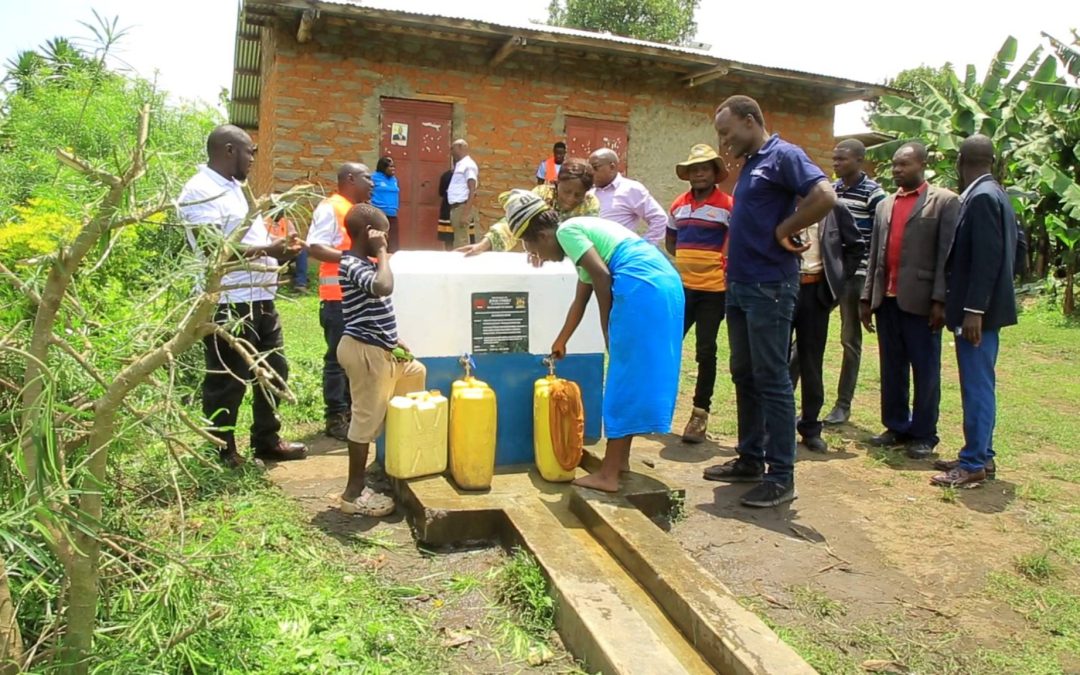
KABAROLE DISTRICT, Uganda — In a significant step toward improving health and sanitation in rural Uganda, The Church of Jesus Christ of Latter-Day Saints recently partnered with UNICEF and the International Water and Sanitation Centre (IRC) to deliver clean water and sanitation facilities to communities in Kabarole and Bunyangabu districts.
The initiative, funded through a $300,000 Church grant in 2024, focused on implementing Water, Sanitation, and Hygiene (WASH) infrastructure in schools, health centers, and local communities. In Kabarole District, the IRC, working alongside the local government, completed Phase I and Phase II of the Buhara Piped Water Scheme. The project included transmission and storage infrastructure, water quality systems, five public standposts, and ten household connections, all completed by April 2025.
In neighboring Bunyangabu District, four new sanitation facilities were constructed at Kibiito Primary School, Rubona Primary School, Kabonero Health Center III, and Kibate Health Center III.
On September 30, 2025, a formal handover ceremony marked the completion of the project. Attendees included Church representatives Elder Fredrick Kamya, Area Seventy; Denis Mukasa, Regional Humanitarian Services Manager, Africa Central Area; and Dinah Mbawaire, National Communication Director. IRC Uganda was represented by Country Director Jane Nabunnya Mulumba and key WASH officials, while district officials and community leaders also participated.
Honorable Richard Rwabuhinga, Chairperson of Kabarole District local government, praised the partnership, noting that access to safe water in the district had increased from 65% to 77% since 2018 and could reach 80% following the completion of the Buhara water project. “The generous contribution of the Church has allowed us to accelerate these critical infrastructure projects,” he said.
The day’s events began with a visit to an 80,000-liter water tank on Magunga Hill in Bwanika Parish, followed by stops at public tap stands to test system performance and engage with local residents. At Rubona Primary School, students performed traditional dances, songs, and poems to welcome the guests. The school’s WASH health club, known as the “WASH Angels,” actively promotes hygiene education both in school and in the surrounding community.
Before the improvements, Rubona Primary faced significant challenges, including long queues for toilets during break times. “Before the construction of the new washrooms, we were getting large numbers of students lining up to use the facilities. Now, we don’t have that burden,” said a school administrator.
Community leaders echoed the sentiment, noting that access to safe water and sanitation could help reduce waterborne diseases such as bilharzia and support broader development in the region. James Ategeka, district chairperson of Bunyangabu, highlighted improvements in school enrollment and academic performance following the introduction of better water and sanitation facilities.
Elder Kamya, representing the Church, emphasized the moral foundation behind the initiative. “This is about love—love for our neighbors, as Christ taught,” he said. Mrs. Mulumba encouraged students to maintain personal hygiene and continue their education, calling the new facilities “a symbol begging you to stay in school.”
The collaborative project demonstrates the impact of public-private partnerships in addressing basic human needs in underserved communities. By providing clean water and modern sanitation facilities, these initiatives are poised to improve health, education, and overall quality of life in rural Uganda.


Latest posts by Moroni Channel News (see all)
- Church of Jesus Christ donates healthcare buildings to two Cambodian hospitals for free - March 10, 2026
- Church of Jesus Christ cancels sacrament meeting in Orem after break-in worries - March 9, 2026
- Do we follow the Prophet only when it’s convenient? - March 5, 2026
- Church of Jesus Christ issues statement on Iran strikes - March 1, 2026
Related posts:
 Church Clarifies Caffeine Use to Latter-day Saints
 Church Leaders Encouraged Members To Extend Love And Encouragement To The LGBT Members
 Church Members In West Virginia Have Been Identified As Safe After Major Flooding In West Virginia
Church Representatives Support Prayer Breakfast at UK Parliament
Church Members In West Virginia Have Been Identified As Safe After Major Flooding In West Virginia
Church Representatives Support Prayer Breakfast at UK Parliament